“Is it death?” – thought Andrey Bolkonsky in “War and Peace”. A few moments ago a cannon ball has landed nearby. His adjutant yelled “to the ground”, yet he for a reason unknown to us, hesitated, observing for a few moments the smoking shell on the grass.
Was it fate from the beginning?
The cannon ball was shot by a gun of Napoleon’s army. Based on the position of Andrey’s regiment, it was probably a 12-pounder. For the final outcome it probably does not matter whether the explosive shell of the 12-pounder is to land 12 cm to the left or to the right from the body, hit it directly to the head or to the leg for the radius of explosion is 3-5 meters. Therefore, for the sake of the question we describe the shell as a point in space. Similarly, Bolkonsky’s body can be taken, despite its complex structure seen from above, as a point in space. Accuracy on the scale of 3-5 meters, however, can be of importance.
Imagine the sight of the artillerist as a straight line originating from (roughly) the initial position of the ball. To specify a position of a point, we would need to say how many meters is the point along this line (usually x), how far it deviates to the left (y) or to the right, how many meters it is above or below the altitude of the gun’s barrel (z). Therefore, we need 3 numbers. Taken together, they constitute the coordinate (x,y,z). Let us take the initial position (at t=0 s) of the shell as the origin R0=(0,0,0). That’s the coordinate system, its introduction is attributed to a French mathematician of the 16-17th century Rene Descartes.
We can position Andrey somewhere 1800 m to the East from the French artillery of the 19th century and, for simplicity, on the same ground level. His position, therefore, at t=0, is RB=(1800,0,0), making a sensible assumption that the gunman was looking along the line of fire.
Once the powder in the gun was ignited, the bullet has acquired initial velocity. To define it, we would need to take 2 successive shots separated by a very small time dt. One can be taken at t=0, and another, say, at a moment dt when the ball was x1 meters away from the barrel, at a position r1=(x1, 0, 0).
The velocity is defined as a difference of two positions divided by the time interval between them. Hence it is v=(r1-r0)/dt=(x1,0,0)/dt m/s. In classical mechanics, velocity (v) and coordinate (r) specify the state of the physical object, a cannon ball in this case. In case a system as a whole has many things, the state constitutes coordinates and velocities of all bodies.
Velocity does not represent a position of a point, it is not a coordinate, it is something else. It is a vector. To properly introduce it, we are now to make a detour from jungles of classical mechanics to fields and crops of linear algebra.
In 3D, vectors, just like coordinates, also represented by 3 numbers. These are objects (we can draw it as arrows — objects with length and direction) that we can sum and also multiply by a number. They are usually denoted as lowercase letters with arrows above (or in italic, or with bar, or in boldface). There is no point of summing coordinates of points per se, and the point does not have a direction, however, we can formally put in a correspondence to each point Ri a radius vector ri: a vector emanating from the origin and ending at the desired point.
Another thing, besides summing and multiplying, we can do is to project one vector onto another. For example, to know how fast the bomb falls from above (or rises in the negative direction), we can project its velocity v onto vector (0,0,-1).
Clearly, the projection of a vector v onto itself is a length |v| by definition.
If we know that the bomb is at r(t), we might be interested in learning in how far it is in the direction of Prince Andrey. It will be given by |r(t)|cos(theta), where theta is the angle between r(t) and rB. It can be denoted as (r(t),rB)/|rB| (see Fig.1), where the bracket is an operation called the scalar product, and |r(t)| is to denote the length of the vector rB:

Let us introduce basic vectors: x, y, z, all with the length of 1. The first points towards East, second towards North, third away from the Earth’s core. Any other vector can be represented as a sum of those multiplied by some numbers. A set of vectors with this property called basis.
Note that if we take rt as a hypothenuse and r1 along x, then |rt|r1cos(theta) is rtx r1. Similarly, if r1 is along y, then |rt|r1 cos(theta) is rty d and same for z. Since we can represent a vector rt as a sum of x, y, z, it is clear that the scalar product of two vectors is given by the sum over products of their components:

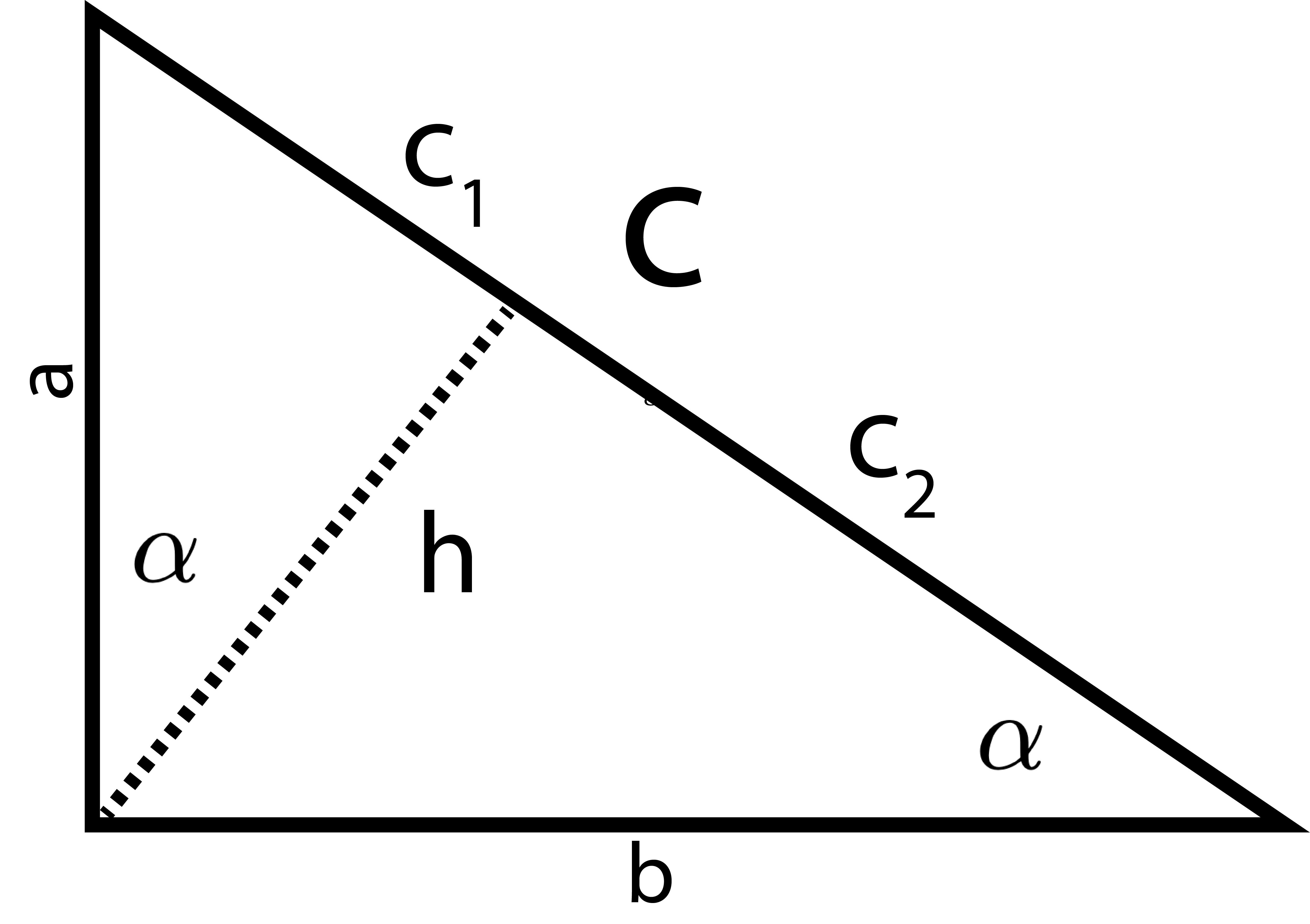
From here, and the fact that the 2D vector along the hypothenuse (c) can be represented as a sum of two orthogonal sides (a and b), the most apt proof of the Pythagorean theorem follows. Vectors are quite useful.
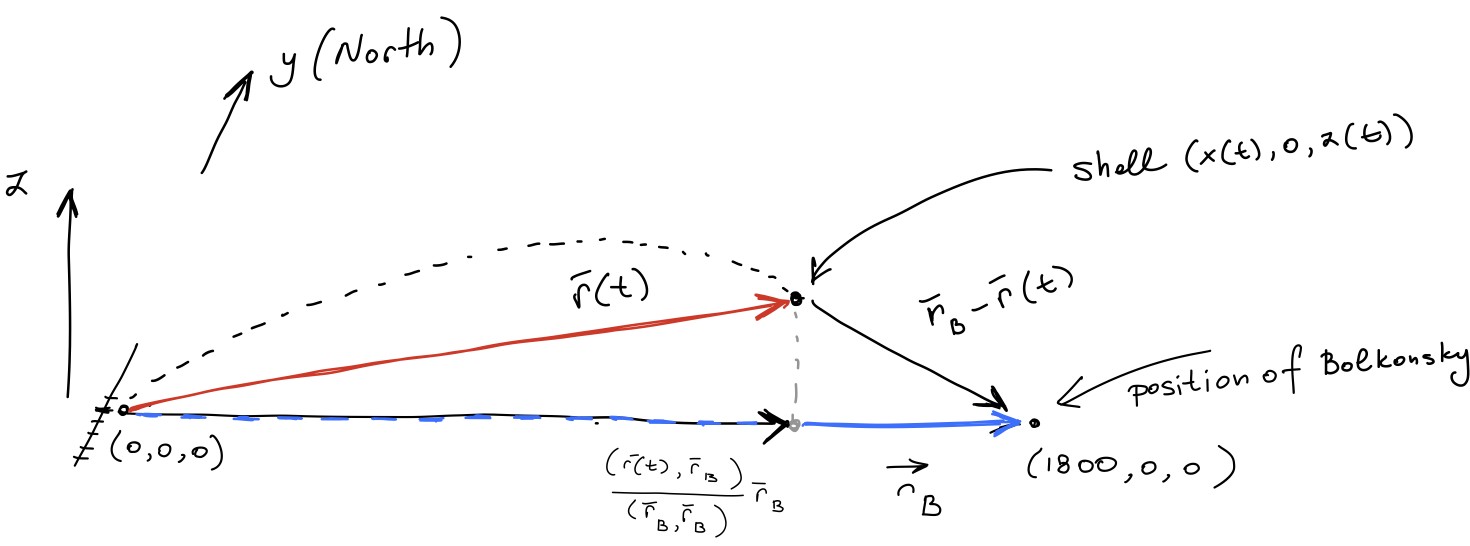
Fig 1. Relative positions of Napoleon's artillery (0,0,0), Bolkonsky (rB), and the shell (r(t)). rB is the estimate based on the novel's text and the map of the battlefield.
What about Bolkonsky? With the gun and the ball, it is very simple. Classical mechanics says that the state of a single object composed out of the coordinate and velocity, as well as properties of the media, fully determines its trajectory whenever interactions with other objects are unimportant. It is unlikely that the flight of the cannon ball will be interrupted by a bird, another cannon ball or divine intervention, therefore the only factors substantially affecting trajectory is the initial state of the shell, influence of the media (air), as well as gravity of the Earth.