Some individuals discover something that changes their life for the better significantly. For many, the event of the discovery is accompanied by the pleasant feeling of excitement.
Often it is something known to many others. People who acquire and systematize new knowledge are, in majority of cases, scientists. However a scientist or not, a human often starts spreading newly acquired knowledge – a behavior trait that probably has an evolutionary origin reinforced by the society. For example, it was forbidden to kill messengers in the Ancient Greece: they had diplomatic immunity and were highly respected. Priests of Ancient Egypt enjoyed a high societal status.
People who ever camped will agree how amazing fire is: you can make food easier to digest and safer to consume, expand the geography and temperature regimes, avoid becoming ill because of the poor weather. It is amazing that an entity using an external object (fire) can expand its range, making one of a multi-continent species without modifying our biology. One of the earliest evidence of usage of fire is in the form of the burned lithics from the Koobi Fora in East Africa and dated 1.5 million years. As far as I know, we did not grow wings or modified our lungs to expand from Africa, but rather resided to advancement of technology and knowledge. When applications of fire were discovered, life of less advanced humans could be dependent on efficiency of communication.
My big discovery, made in the middle school, was a concept of the mathematical proof. At the beginning of the geometry class, I did not understand the purpose of the formal proof. I tend to think that mathematical or logical proofs are unknown to most of the animals, including hunting or gathering primates. It is both the variety of the different external conditions and finiteness of the human brain that led to this type of knowledge storage.
Indeed, what is the point of proving the Pythogerean theorem?
Every pupil equipped with a ruler, pencil and a sheet of paper able to draw can show that a rectangular triangle with two sides of length 3 (a) and 4 (b) has the longest side (c) of length 5. 9 plus 16 is 25, hence a relation c^2=a^2+b^2 between its sides exists. This triangle was known to Ancient Egyptians, who used a rope segmented into 12 pieces to make borders of fields perfectly rectangular.
One can try drawing other rectangular triangles with, say, length of sides 9 and 12 to learn that the largest side has a length of 15. Clearly, a relation c^2=a^2+b^2 exists. What is the point of lengthy and abstract proof residing on some other statements?
The point is that, strictly speaking, we showed that such relation is true for only two cases. It would be sensible to assume that this is case for all such triangles, but we all know that our intuition fails quite often. At this point, it is just an empirical observation that for two particular triangles such relation between the sides holds.
We may ask whether there are more such triangles where the relation holds? We can, for example, make lengthy tables with such triangles, each entry with three numbers (a,b,c):
(3,4,5)
(5,12,13)
(7,24,25)
…
We would then either have such book, or memorize it to be able to build a pyramid or nail windows from vandals.
The mathematical proof, however, will make a relation valid for any triangle: drawn on a paper, on a road with any length of sides. Drawn with a red pen, green pencil or blue chalk. Any kind of triangle! Such proof will contain much more knowledge than a big and possibly expensive book with numbers. It will be a statement applicable for an infinite number of geometrical objects.
This wisdom applicable for any kind of geometrical object of this kind is clearly more than just the empirical observation for a finite number of them, from which we started.
In my opinion, the most apt way to prove such relation comes from the scalar product. Since 3 sides form a triangle, for vectors it should be a+b=c, and hence (a+b,a+b)=(c,c), which for orthogonal a and b implies that a^2+b^2=c^2. It does, however, involve concepts of vectors and scalar products that could be unknown to agriculture workers of the ancient Egypt or Greece.
A simple law for the area of the triangle, however, must have been known for otherwise it was hard to figure out how many crops a given field is supposed to produce.
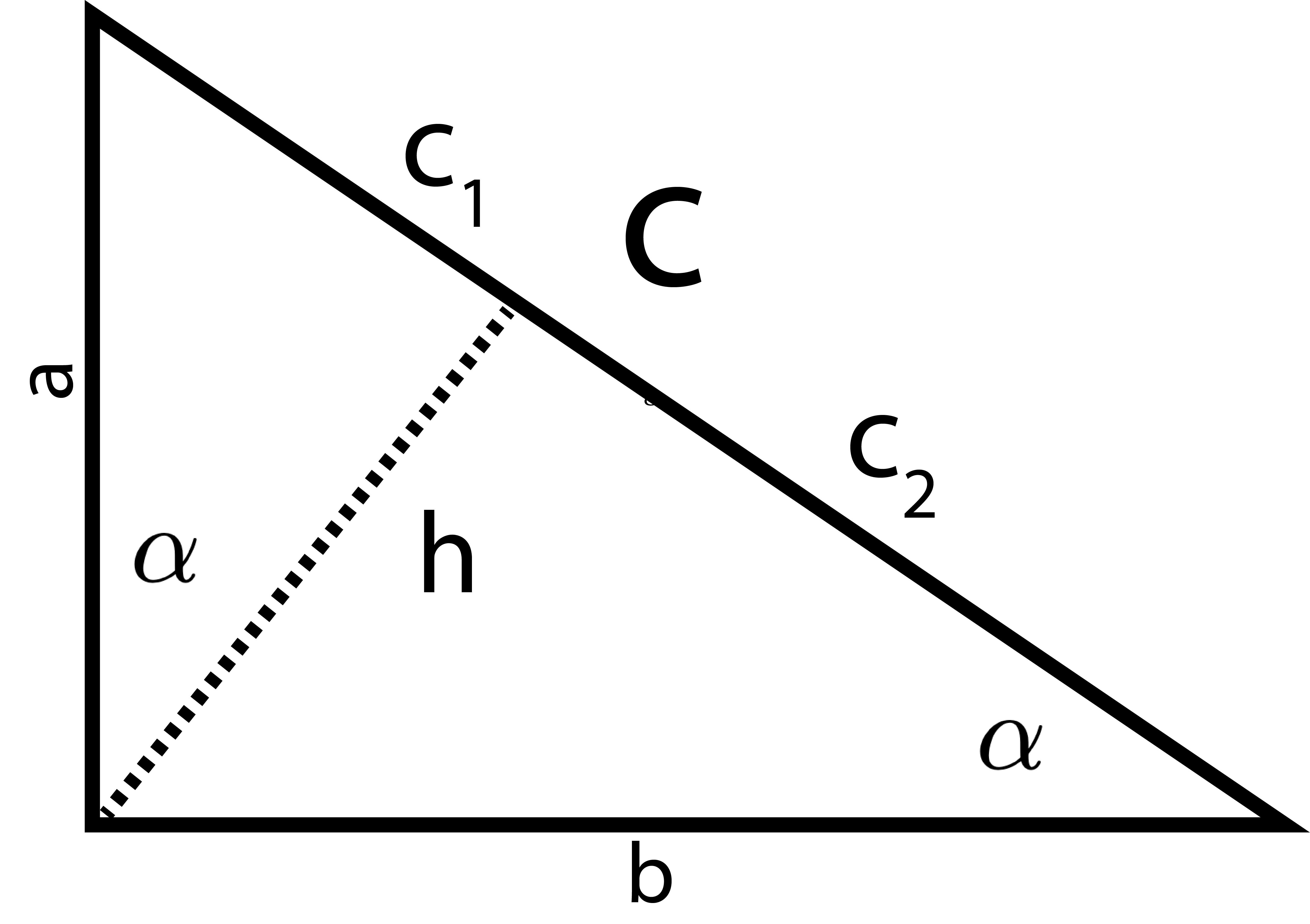
Consider a triangle drawn on a Figure 1. Triangle (c) can be divided into two, each with area:


The total area of the third is:

Since the area of Sc can be expressed as a sum of Sa and Sb, we complete the second proof of the Pythogerean theorem.
Another way to prove it comes from the way area should scale: the area of a rectangle goes as a square of its diagonal multiplied by the same function of an angle between it and its side and since triangle is a half of rectangle, it should scale quadratically the same way. We can again divide one big triangle into two smaller, and find, just like before, that a^2+b^2=c^2.
We went through three different proofs of the Pythagorean theorem (the first can be also used to prove a cosine formula). I have communicated a discovery I made in a middle school: the infinite value of the mathematical proof as a technology to produce new knowledge.